AI Governance in Higher Education: A Practical Framework for Institutions in 2026

AI governance in higher education is the set of institutional policies, oversight structures, and technical controls that determine how artificial intelligence systems are procured, deployed, monitored, and retired across a university or college. It covers everything from student data privacy and academic integrity to faculty consent, vendor due diligence, and audit accountability.
AI is already operating across most institutions whether formal governance exists or not. Students are using generative AI tools to draft assignments. Faculty are running AI grading pilots. LMS vendors have embedded AI features directly into course management workflows. The practical question is no longer whether to govern AI but whether institutional governance can keep pace with the speed of deployment.
This guide is written for the people responsible for answering that question: CIOs, Provosts, Chief Digital Officers, and Heads of Teaching and Learning who need a governance framework grounded in institutional reality, regulatory obligation, and practical implementation.
What does AI governance in higher education actually mean?
AI governance in higher education means the policies, structures, and accountability mechanisms an institution uses to manage how AI systems are selected, deployed, used, and overseen across academic and operational functions. It is not a single IT policy or an acceptable use statement alone.
In practice, AI governance spans several institutional domains that do not always sit within the same reporting line. Data privacy determines what student information AI systems can access and how it is stored or processed. Academic integrity policy defines what AI-assisted work is permissible and under what disclosure conditions. Procurement criteria govern which AI vendors meet the institution's security, transparency, and compliance requirements before a contract is signed. Faculty and student consent frameworks establish who was informed of AI deployment and what choices they were given. Audit and oversight mechanisms ensure there is a record of what AI systems did, what data they touched, and who approved their use.
The reason governance is often reduced to IT security policy is that IT is the department most likely to notice when an AI tool is processing student data without authorization. But a governance framework that lives only in IT will miss the academic integrity, faculty relations, and procurement dimensions that create the most significant institutional risk. Effective AI governance is a cross-functional institutional responsibility.
Why do universities need an AI governance framework now, not later?
Universities need an AI governance framework now because several external regulatory timelines and internal risk factors are converging simultaneously. Waiting for a single catalyst to force action means governing reactively after incidents have already occurred.
The regulatory environment has shifted from voluntary guidance to binding obligation in multiple jurisdictions. The EU AI Act, in force since August 2024, classifies AI systems used in educational and vocational training as high-risk when they influence access, progression, or assessment. FERPA obligations in the United States are triggered the moment an AI system processes, stores, or transmits personally identifiable student information. Many institutions have deployed AI tools without completing the formal assessment of whether those tools qualify as school officials under FERPA's legitimate educational interest standard, which creates direct legal exposure. The pace of regulatory development in APAC, Latin America, and Canada is accelerating alongside these frameworks, and institutions that have built governance infrastructure for one jurisdiction will be substantially better positioned to meet obligations as they emerge elsewhere.
The procurement risk is equally immediate. According to The Impact of AI on Work in Higher Education (EDUCAUSE, January 2026), 94% of higher education workers report using AI tools for work within the past six months, but only 54% are aware of their institution's AI policies. That report, produced in partnership with AIR, NACUBO, and CUPA-HR, surveyed 1,960 staff, administrators, and faculty across more than 1,800 institutions. The gap between adoption and policy awareness is not a communications problem — it is a governance gap. When faculty and staff use AI tools that have not been procured through an institutional pathway, institutions lose visibility into what data those tools are processing, what vendors hold student information, and what audit trail exists.
Student-side data reinforces this picture. According to the HEPI/Kortext Student Generative AI Survey 2026, 94% of UK undergraduates now use generative AI to help with assessed work. Two-thirds report that assessment has changed significantly in response to AI. And while 68% of students believe AI skills are essential to thrive in today's world, fewer than half feel their teaching staff are helping them develop those skills — a 20-percentage-point gap that reflects institutional under-preparation at exactly the moment student AI use has become near-universal.
Reputational risk follows governance gaps. When an AI tool used in an assessment context produces a contested output and there is no institutional record of how the tool was vetted, what data it accessed, or who approved its use, the institution has no defensible position. The academic integrity implications extend to accreditation review, student appeals, and in some jurisdictions, formal regulatory inquiry.
The institutions that build governance frameworks now will spend the next two years iterating on working systems. Institutions that wait will spend the same period explaining why they did not.
Add an image from one of the surveys maybe?
What should an AI governance framework for higher education include?
A complete AI governance framework for higher education covers six interconnected areas. No single area is sufficient alone, and gaps in any one area create exposure that the others cannot compensate for.
Acceptable Use Policy
An acceptable use policy defines what AI-assisted activity is permitted for students, faculty, and staff, under what conditions, and with what disclosure requirements. Effective policies are differentiated by context: what is appropriate in a drafting workflow differs from what is appropriate in a high-stakes assessment. Policies written at the institutional level need to allow for course-level specificity without creating a patchwork that is impossible to enforce or communicate.
Data Governance
Data governance for AI covers which student, faculty, and institutional data AI systems can access, how long that data is retained by the AI provider, where it is processed and stored, and under what conditions it may be used to train or improve an AI model. Third-party AI vendors that process student data under a service agreement must be assessed against FERPA, GDPR, and any applicable local data protection law before deployment, not after.
Risk Classification
Risk classification assigns each AI tool a risk tier based on three factors: the sensitivity of data it accesses, the impact of decisions it influences, and the degree to which it operates without human review. A tool that analyzes anonymized engagement data for course improvement sits in a different risk tier than a tool that generates summative assessment feedback that instructors may adopt without independent review. Classification determines what procurement and oversight requirements apply. See the section below on how to classify AI tools by risk level for a detailed framework.
Procurement Criteria
Procurement criteria translate risk classification into vendor requirements. High-risk tools require evidence of data processing agreements, transparency documentation, human oversight mechanisms, and demonstrated compliance with applicable regulation before procurement can proceed. Procurement criteria should be formally documented and applied consistently so that individual departments cannot onboard AI tools outside the institutional pathway simply because no one reviewed the decision.
Faculty and Student Consent Frameworks
Consent frameworks establish who is informed of AI deployment in their learning or working environment, what they were told, and what options were available to them. For AI systems that process student work or influence academic outcomes, consent is both an ethical and a regulatory consideration. Institutions that can document what was communicated, to whom, and when are in a substantially stronger position when a governance question arises.
Audit and Oversight Mechanisms
Audit mechanisms provide the institutional record of what AI systems did, what data they processed, which outputs were reviewed by a human before being acted upon, and which decisions were made without AI involvement. Oversight mechanisms ensure that audit data is reviewed regularly by people with the authority to act on it. Without audit capability, governance exists only on paper.
.png)
How should institutions govern AI inside their LMS specifically?
Governing AI inside the LMS requires institutions to ask different questions of AI layer providers than of standalone tools, because LMS-embedded AI operates inside the same environment as student grades, course content, and instructor communications.
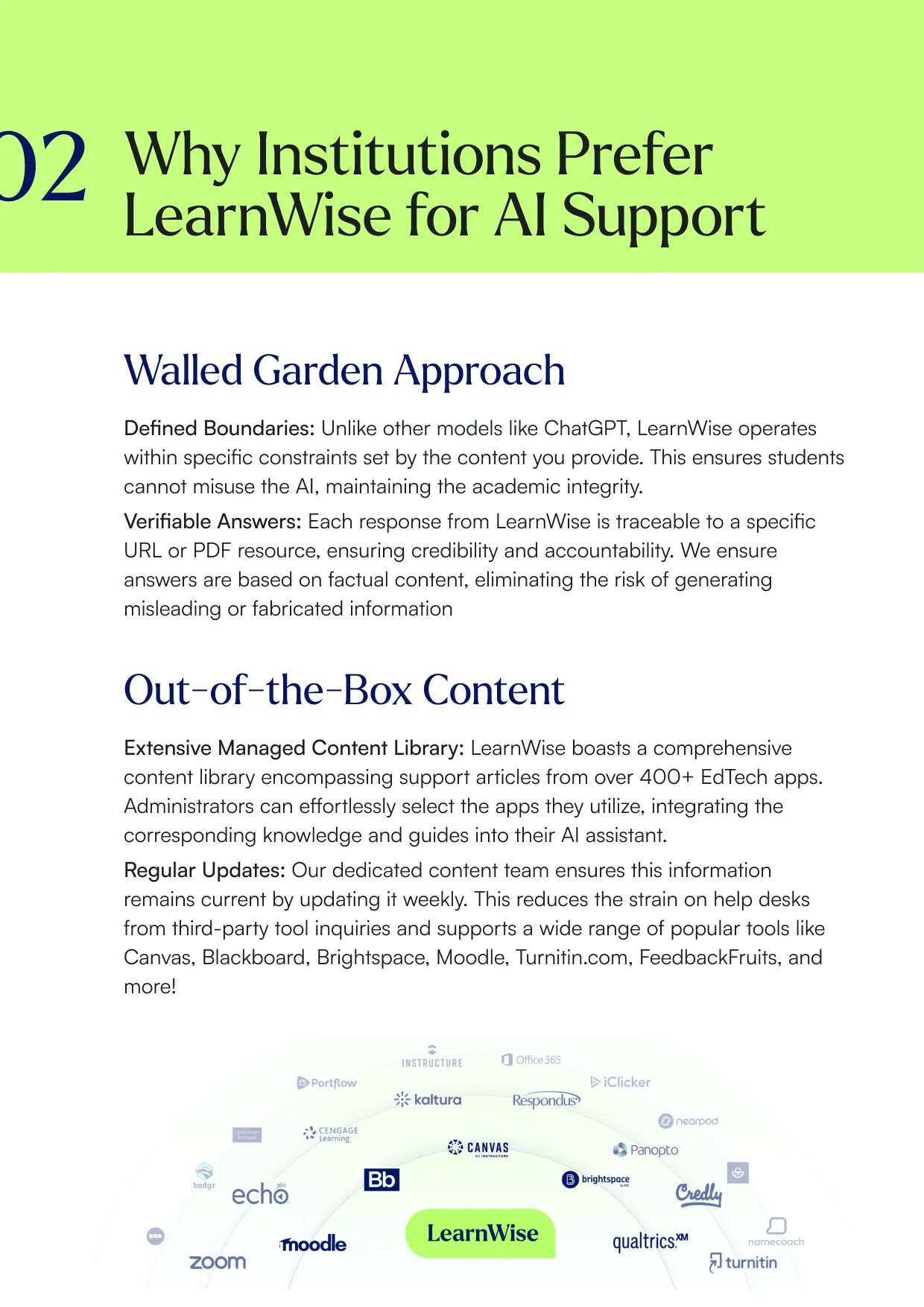
The first governance question to ask of any LMS-integrated AI provider is whether the AI is walled inside institutional content or whether it draws from external sources the institution does not control. A walled-garden AI approach means the system only retrieves information from content the institution has explicitly made available within the LMS environment. Every response can be traced to a source document the institution controls, which creates the audit trail that governance requires. AI that draws from the open web or an external training corpus cannot provide the same traceability guarantee.
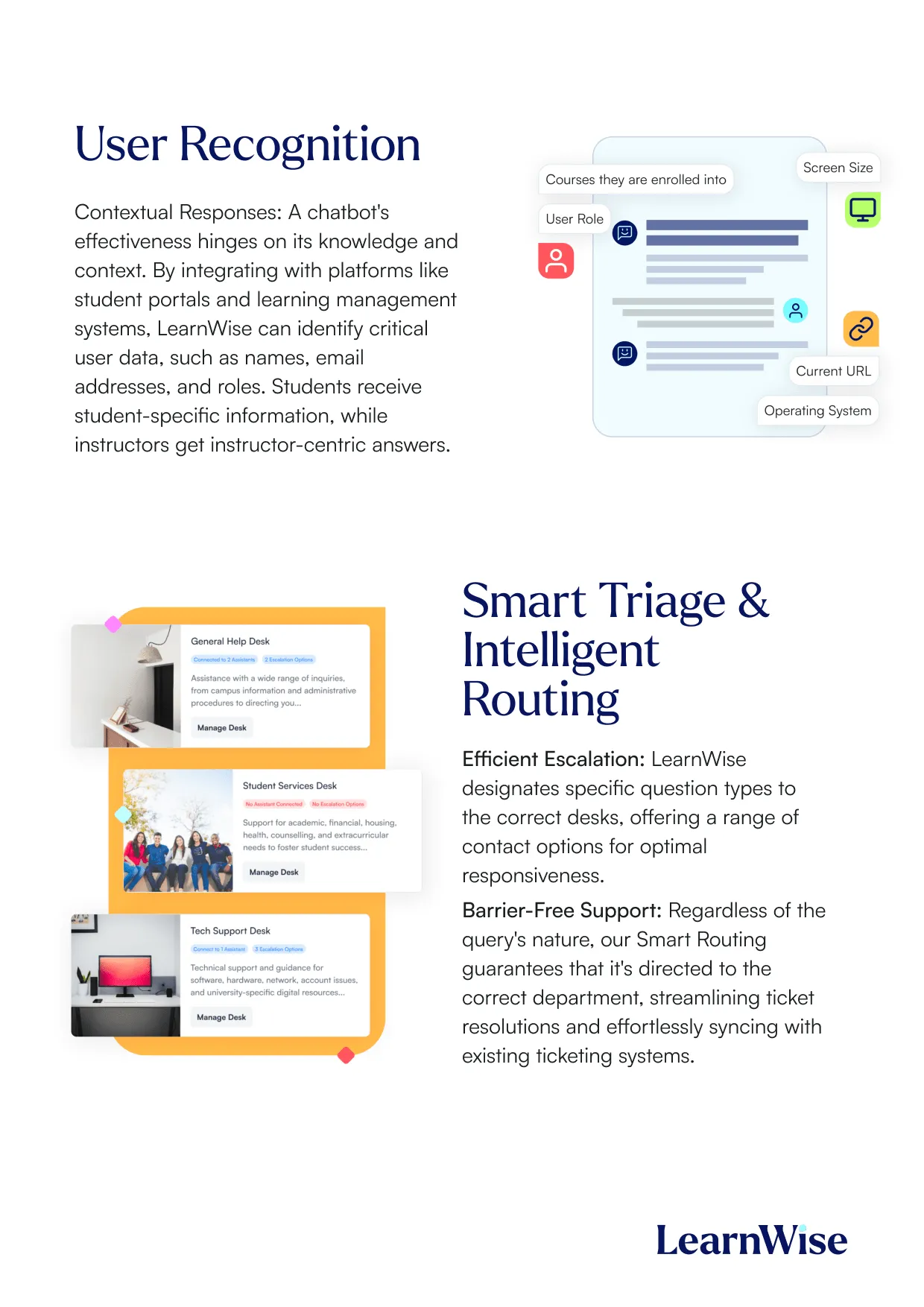
The second question is role-based access control: does the AI system enforce the same access boundaries that the LMS already applies? A student-facing AI should not be able to surface content from an instructor-only resource. A faculty-facing workflow tool should generate outputs that go to the instructor for review before any action is taken in the gradebook or the student record. The distinction between AI that assists a human decision and AI that acts without human review is the central governance question in the LMS context.
Audit logging at the LMS level means maintaining a record of what queries were submitted, what content was retrieved, what responses were generated, and whether a human reviewed the output before it was applied. This record needs to be accessible to institution-side administrators, not just the AI vendor. LearnWise's approach to LMS governance is documented at the Trust and Safety Hub, including data residency, audit capability, and compliance certifications.
For institutions considering the faculty-facing dimension of LMS AI governance, the AI Ops Assistant operates on the principle that AI-generated suggestions require instructor review and approval before any action is taken. Faculty retain full control over every output the system produces. No AI action is applied to student records or course content without explicit human sign-off.
For the broader question of how LMS integrations are structured from an AI governance perspective, the AI in the LMS guide covers how AI operates within Canvas, Moodle, D2L Brightspace, and Blackboard environments in detail.
.png)
Download the study


Download the whitepaper

What AI regulations apply to universities, and how do they vary by region?
The regulatory landscape for AI in higher education is now global, moving, and no longer confined to GDPR and the EU AI Act. Institutions serving students across multiple regions, or procuring AI from international vendors, need to understand the obligations that apply in each jurisdiction where they operate.
European Union and Ireland
The EU AI Act entered into force in August 2024 and remains the most comprehensive binding AI regulation applicable to higher education. AI systems used in educational and vocational training that influence access, progression, or assessment fall under the high-risk category in Annex III. That classification carries obligations including fundamental rights impact assessments, audit logging, human oversight mechanisms, and transparency toward affected students.
The original compliance deadline for Annex III high-risk systems was 2 August 2026. On 7 May 2026, however, the Council of the EU and the European Parliament reached a provisional political agreement on the Digital Omnibus on AI, the first set of amendments to the AI Act since its adoption. The agreement extends the Annex III high-risk compliance deadline to 2 December 2027. Formal adoption and publication in the Official Journal is expected before August 2026, at which point the extension becomes binding law.
Two important caveats for institutions. First, the extension does not mean compliance preparation can wait: the agreement itself emphasizes that implementation work should already be underway, and December 2027 will require completed conformity assessments, risk management systems, audit trails, and registration in the EU AI Act database. Second, the Article 50 transparency obligations,m which require disclosure when users interact with AI systems, are not covered by the extension and remain on schedule for August 2026. Institutions deploying student-facing AI tools need to be ready for that date regardless of the Omnibus.
One additional live development: as of May 2026, the European Commission's AI Office is actively seeking feedback on draft guidelines for the classification of high-risk AI systems. The precise scope of what constitutes high-risk in education contexts has not yet been fully codified. This matters for vendor due diligence: institutions should ask AI providers how they are tracking the classification guidance as it finalizes.
The Act has extraterritorial reach: universities outside the EU that process data from EU-based students, or that partner with EU institutions, may fall within scope. For institutions also operating under GDPR, AI systems that process personal data about students or staff must comply with data minimization, purpose limitation, and lawful basis requirements. For most assessment-adjacent AI uses, legitimate interest is a weak lawful basis; explicit consent or a clearly defined contractual basis is more defensible. Irish institutions are subject to the full scope of both GDPR enforcement by the Data Protection Commission and AI Act obligations.
United Kingdom
UK institutions post-Brexit operate under UK GDPR and the ICO's evolving AI guidance. No dedicated binding AI statute is imminent: an anticipated UK AI Bill did not materialize during 2025, and whether legislation will appear in 2026 remains uncertain. The government's current focus is on AI Growth Zones and AI Growth Labs - regulatory sandboxes for real-world AI testing - with ministers taking the position that existing data protection, competition, equality, and online safety law already applies to AI systems.
In practice, the principles underpinning responsible AI governance, such as transparency, human oversight, data subject rights, and audit accountability, are embedded in ICO enforcement expectations and the government's voluntary AI assurance guidance. These should be treated as a compliance floor, not a ceiling. Institutions serving students in both the UK and EU, or operating campuses across both jurisdictions, should apply EU Act compliance as the higher standard for those deployments and maintain it consistently.
United States and Canada
US institutions operate without a single federal AI statute but face binding obligations through FERPA, which is triggered the moment an AI system processes, stores, or transmits personally identifiable student information. AI tools deployed in student support, advising, or assessment contexts must be assessed against FERPA's school official standard before procurement proceeds. State-level legislation is developing unevenly: California has led on AI transparency requirements, but institutions operating nationally face a patchwork of state obligations that no federal framework has yet resolved. The US Department of Education's AI guidance provides additional context on data privacy expectations for institutions navigating this gap.
Canada's proposed federal AI legislation, the Artificial Intelligence and Data Act (AIDA), part of Bill C-27, died on the order paper in January 2025 when Parliament was prorogued. Canada currently has no binding federal AI framework. Institutions with Canadian campuses or partnerships are operating under PIPEDA, provincial privacy laws (particularly Quebec's Law 25, which has materially stronger data protection requirements), and voluntary alignment with EU-standard baselines as a practical floor.
Latin America
Brazil's Lei Geral de Proteção de Dados (LGPD) applies to any processing of personal data that takes place in Brazil, that involves data subjects located in Brazil, or where the processing offers goods or services to individuals in Brazil. AI systems deployed in Brazilian higher education contexts must comply with LGPD's consent, purpose limitation, and transparency requirements.
Brazil is also significantly further along on standalone AI legislation than most of the region. The Federal Senate approved Bill No. 2338/2023 in December 2024 and forwarded it to the Chamber of Deputies in March 2025. As of June 2026 the bill has not yet passed the Chamber and is not law, but its direction is well established: a risk-based framework aligned closely with EU AI Act principles, with education AI classified as high-risk, and the national data protection authority ANPD expected to serve as the lead supervisory body. Institutions with partnerships or student populations in Brazil should assess LGPD compliance now for any AI tool that touches student data, and monitor the Chamber's progress on the bill.
Asia-Pacific
The APAC regulatory environment is heterogeneous but moving toward binding frameworks. South Korea's Act on the Development of Artificial Intelligence and Establishment of Trust (AI Basic Act) entered into force on 22 January 2026. It introduces requirements for transparency, risk assessment, human oversight, and documentation for high-impact AI systems, and confirms extraterritorial application where AI systems affect Korean users. Enforcement decrees are still being finalized, with a grace period focused on guidance rather than penalties running through 2026.
China enforces multiple AI-specific regulations, including the Generative AI Services Management Measures, with obligations around consent, data quality, content labeling, user rights, and complaint handling. Australia's national higher education regulator, TEQSA, has required all higher education providers to submit institutional action plans addressing the risks posed by generative AI, with alignment to national quality standards and course-level risk assessments embedded in institutional governance processes. Japan takes a principles-based approach under METI's AI governance guidelines, relying on cooperation and existing law rather than penalties, but embedding expectations around transparency and responsible use that institutions should document and demonstrate.
Vendor Due Diligence Across Jurisdictions
Regardless of jurisdiction, the vendor due diligence questions that matter most are consistent: Can the vendor confirm the risk classification of their system under the applicable regulatory framework? Do they maintain technical documentation that supports institutional audit requirements? Is there a mechanism for the institution to access audit logs independently of the vendor? Has the vendor conducted a data protection impact assessment that covers the specific use case being deployed? Does the system design allow the institution to enforce human oversight before AI-generated outputs are applied to student records or academic outcomes?
How should universities classify AI tools by risk level?
Universities should classify AI tools using a three-tier risk model based on three factors: the sensitivity of the data the tool accesses, the impact of the outputs it generates on individual students or faculty, and the degree to which those outputs are reviewed by a human before being acted upon.
A low-risk tool accesses no personally identifiable student data, generates outputs that are informational rather than consequential, and operates with no connection to gradebooks, student records, or administrative decisions. An AI tool that answers generalized questions about campus facilities using publicly available information, for example, sits in the low-risk tier. Low-risk tools require basic vendor due diligence and an acceptable use statement but do not require a full data protection impact assessment. For a detailed classification methodology and vendor vetting checklist, see the AI tool classification guide.
A medium-risk tool accesses anonymized or pseudonymized student data, generates outputs that inform rather than determine institutional decisions, and operates with some human review before outputs are applied. An AI tool that surfaces early-alert signals based on aggregated engagement data, reviewed by a student success advisor before any intervention is initiated, sits in the medium-risk tier. Medium-risk tools require a data processing agreement, a FERPA or GDPR assessment depending on jurisdiction, and documented human oversight protocols.
A high-risk tool accesses personally identifiable student data, generates outputs that directly influence academic assessments, progression decisions, or access to institutional resources, or operates in a way that reduces human review before consequential action is taken. AI tools in this tier require the full procurement pathway: data protection impact assessment, evidence of regulatory compliance, technical documentation of system behavior, role-based access controls, audit logging accessible to the institution, and a defined incident response protocol.
The most common classification error is treating a tool as low-risk because its outputs are framed as recommendations rather than decisions. If faculty routinely adopt AI-generated feedback without independent review, the tool is functionally operating in the high-risk tier regardless of how its outputs are labeled. Classification should reflect operational reality, not product positioning.
What should a university AI steering committee look like?
A university AI steering committee should include representation from IT, academic leadership, legal and compliance, student services, and active faculty, with a defined mandate, a regular meeting cadence, and clear authority over which decisions require committee sign-off versus delegated departmental action.
The IT or CIO representative brings the technical infrastructure and security perspective: what systems are being integrated, where data flows, what the institution's existing contractual commitments to LMS and cloud vendors look like, and what audit capabilities are available or need to be built. Without this perspective, governance frameworks often describe requirements that cannot be technically enforced.
Academic leadership representation, typically a Provost, Dean of Academic Affairs, or equivalent, ensures that governance decisions are grounded in academic mission and that the committee does not default to pure compliance orientation. Academic integrity policy, the conditions under which AI tools are permitted in assessment, and the implications for accreditation review all require academic authority, not just legal or technical sign-off.
Legal and compliance brings the regulatory mapping: FERPA, GDPR, the EU AI Act obligations, applicable state or national data protection law, and the institution's existing vendor contract obligations. This role is distinct from IT security and should not be collapsed into it.
Student services representation is relevant wherever AI tools interact with student support functions, early intervention systems, or accessibility provisions. Student services staff often have the most direct visibility into how AI tools are actually being experienced by students, which governance documentation rarely captures.
Faculty representation is the dimension most frequently omitted and the most consequential for adoption. Governance frameworks that are designed around faculty without faculty input tend to produce policies that are technically compliant and practically ignored. At least one active faculty member, ideally elected rather than appointed, should sit on the committee and participate in policy design, not just receive the finished document.
The committee should meet at minimum quarterly, with a defined agenda that includes: review of new AI tool requests against classification criteria, updates on regulatory changes affecting existing deployments, review of audit logs or incident reports from the previous period, and a standing agenda item for faculty and student feedback on AI tool experience. Decisions that require full committee sign-off should be documented: any new high-risk AI deployment, any change to the acceptable use policy, and any incident that results in student data exposure or a contested AI-generated academic outcome.
How do you build an AI acceptable use policy that faculty will actually follow?
An AI acceptable use policy that faculty will follow is one that was built with faculty, written in plain language, differentiates by context rather than applying blanket rules, and is backed by technical controls rather than relying solely on individual compliance.
Most AI acceptable use policies fail not because the underlying principles are wrong but because of how they were produced. When IT drafts a policy for faculty without faculty participation, the result is typically a document that addresses the institution's technical and legal risk surface accurately but does not reflect the practical reality of how faculty work. Faculty who receive a policy they did not help design and do not fully understand will route around it, not because they are acting in bad faith but because the policy does not map to their workflows.
Co-designed policies produce different outcomes. When faculty have participated in identifying the specific AI uses they want to permit, the conditions under which AI assistance is appropriate in assessment contexts, and the disclosure requirements they consider reasonable for students, the resulting policy reflects their professional judgment. That makes it significantly easier to communicate, interpret, and apply consistently.
Plain language is a governance requirement, not a stylistic preference. A policy that requires a legal glossary to interpret will not be applied consistently by the people it governs. Every provision in an acceptable use policy should be expressible in a single sentence that a faculty member in any discipline can read and immediately understand what they are and are not permitted to do.
Context differentiation is essential. An AI tool used to generate initial feedback on early-stage student writing drafts operates under different governance conditions than an AI tool used in a summative assessment. A policy that applies the same rule to both will either be too restrictive to be useful in the former case or too permissive to be defensible in the latter. Effective policies establish contextual categories and define the appropriate conditions for each.
Technical controls replace reliance on individual compliance for the provisions where the stakes are highest. If the institution requires that AI-generated summative assessment feedback be reviewed by the instructor before it is released to students, that requirement should be enforced at the system level, not through a policy statement alone. Governance frameworks that depend entirely on individual compliance will fail at scale.
A six-month review cadence is appropriate for acceptable use policies in the current environment. AI capabilities, vendor practices, and regulatory guidance are all evolving faster than annual review cycles can accommodate. The review process should include a standing survey to faculty on policy clarity and workability, not just a legal and compliance review.
Academic integrity implications should be addressed specifically and directly, not covered by a general reference to the institution's existing academic integrity policy. Students need to understand what AI assistance is permitted in which contexts, and faculty need guidance on how to evaluate suspected policy violations when AI involvement is ambiguous. These are genuinely new questions that existing academic integrity frameworks were not designed to answer.
.png)
Download the whitepaper
What does good AI governance look like at 6 months, 12 months, and beyond?
Good AI governance is a maturity progression, not a binary state. Every institution starts at a different point depending on what AI tools are already deployed, what existing policy infrastructure exists, and what regulatory environment applies. The stages below describe what functional governance looks like at each horizon, not grades for where an institution should already be.
At 6 Months
At the six-month mark, a governance-functional institution has a published acceptable use policy that differentiates between contexts and has been communicated to faculty and students. It has completed a basic inventory of AI tools currently in use across academic and administrative functions, with an initial risk classification applied to each. It has established a data processing agreement with every AI vendor that handles student or staff data. It has implemented basic audit logging for the AI systems most likely to affect academic outcomes, and it has a defined pathway through which new AI tool requests are reviewed before deployment. The steering committee may not yet exist in final form, but there is a named owner for AI governance decisions at a senior level.
At 12 Months
At twelve months, the governance structure is operating rather than being built. The steering committee meets on a defined cadence and has processed at least one significant AI tool decision. The risk classification process is embedded in procurement: no high-risk AI tool can be deployed without completing the full vetting pathway. Faculty have received structured guidance on AI use in their specific disciplinary and assessment contexts, not just a general policy document. Audit logs are being reviewed on a regular basis by someone with the authority to act on what they find. The institution has a documented position on the EU AI Act obligations that apply to its current AI deployments, regardless of geography.
Beyond 12 Months
Beyond twelve months, mature AI governance means the intake pathway for new AI tools is routine and predictable enough that departments use it without prompting. Governance is incorporated into LMS vendor contract renewals and into the evaluation criteria for any new educational technology procurement. The acceptable use policy has been through at least one formal revision cycle incorporating faculty and student feedback. Audit and oversight mechanisms have caught and responded to at least one incident where AI behavior did not align with institutional policy, and the response was documented and communicated appropriately.
The institutions that are furthest ahead at this stage are not the ones that built the most comprehensive policy documents in year one. They are the ones that treated governance as an operational capability from the beginning, iterated based on real experience, and kept faculty and students involved in the process as it evolved.
.png)
Effective AI governance is a foundation, not a finish line
The institutions that benefit most from AI in higher education over the next decade will not be the ones with the most advanced AI tools. They will be the ones with the governance infrastructure that allows them to adopt, adapt, and account for those tools with confidence.
Ungoverned AI creates compounding risk: vendor contracts signed without data protection assessment, AI tools embedded in assessment workflows without audit capability, faculty operating without policy clarity, and students whose data and academic outcomes are affected by systems that were never formally reviewed. Each of these risks is manageable in isolation. Together, they create a governance debt that becomes significantly harder to address once it has accumulated.
The framework outlined here is not a compliance checklist to complete once. It is the architecture of an ongoing institutional capability. Acceptable use policies need revision as AI capabilities change. Risk classifications need re-evaluation as tools evolve beyond their original scope. Audit mechanisms need to keep pace with the AI systems they are overseeing. Steering committees need to remain active rather than becoming rubber stamps.
LearnWise is built for institutions that take AI governance seriously. Every product in the platform, from AI Campus Support to the AI Ops Assistant, is designed around the governance principles covered in this guide: walled-garden content access, role-based controls, full audit capability, and human oversight at every consequential decision point. Certifications including ISO 27001, SOC 2 Type II, FERPA, and GDPR compliance are documented at the Trust and Safety Hub.
If you are building or revising your institution's AI governance framework and want to understand how a governed AI layer inside your LMS works in practice, request a demo and speak with the team.

.svg)





.webp)
%20(1).webp)
%20(1).webp)