Building Blackboard Together 2026 Recap: What's New, What's Next

What we took away from Building Blackboard Together 2026
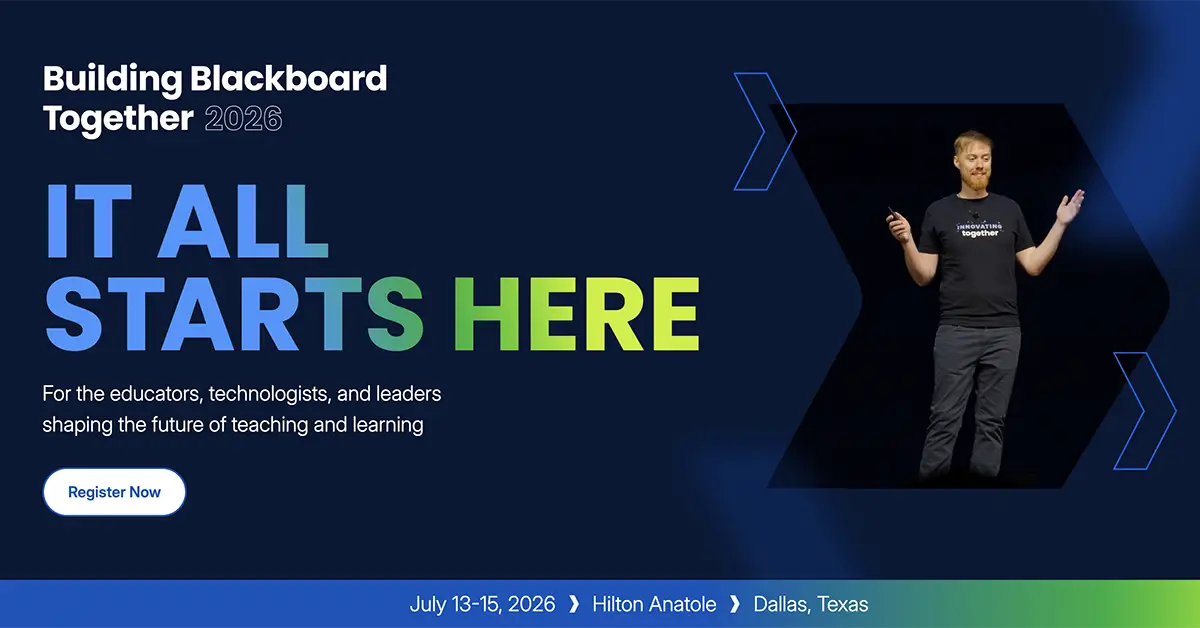
Building Blackboard Together 2026 wrapped up in Dallas last week, and it was one of the most anticipated LMS user conferences of the year. Three days at the Hilton Anatole, keynotes designed for institutional leaders rather than product spectators, and the first user conference under a newly rebranded, debt-free Blackboard focused entirely on teaching and learning.
For our team, BbT26 was a real signal of where the Blackboard community is heading. Genuine energy across the sessions, a strong institutional case study track, and a program built around the questions institutions are actually asking right now.
Here's what we took away from the conference, what the direction across the Blackboard portfolio means for institutions, and what to keep an eye on next.
What you can't miss from BbT26 this year
If you couldn't be in Dallas, a few themes ran across the conference that are worth flagging for any Blackboard institution planning the next academic year.
The rebrand is real, not cosmetic. BbT26 was Blackboard's first user conference since emerging from Chapter 11 and rebranding from Anthology in March. The framing across the three days was consistent: a standalone, debt-free Blackboard focused entirely on Teaching and Learning, with a portfolio narrowed to Blackboard LMS, Ally, Illuminate, Evaluate, and Institutional Effectiveness. The message from the leadership team was clear. Sharpened focus, faster response times, and a genuine recommitment to the customer relationship.
Community-first was more than a tagline. The community-first framing was the throughline of the entire program. Sessions were dominated by institutional case studies rather than vendor product pitches, the Catalyst Awards ceremony spotlighted real institutional work, and the peer-to-peer content across the tracks felt like the strongest part of the agenda. For a conference titled "Building Blackboard Together," that alignment mattered.
AI has moved from strategy conversation to institutional strategy. The institutions presenting at BbT26 were not describing pilots. They were describing production deployments and the operational lessons from running AI across their student experience. That maturity shift is the story of the LMS conference calendar this year, and BbT26 reflected it clearly.
The big BbT26 keynote takeaways and what they mean for institutions
Two keynote moments defined the tone of the conference.
David Labaree's opening keynote, "Know It Before You Mess With It," set out the structural realities of the American education system that most technology transformations run into and get absorbed by. It was a sharper opening than the usual technology conference keynote, and exactly the right frame to start a program built around what institutions are trying to change.
The fireside conversation between Matthew Pittinsky and Lev Gonick picked up from there. Pittinsky, who co-founded Blackboard in 1997 and is returning as CEO, has spent the last year publicly arguing that AI might finally be the platform shift that breaks the LMS pattern. Gonick, who runs enterprise technology at Arizona State University, has been building that answer in real time. The conversation between them was the strongest AI-focused session on the agenda, and for institutional leaders thinking through what AI actually demands, it was the right pairing.
The takeaway for institutions running Blackboard: this is a company redirecting itself toward the long-term questions of teaching and learning rather than a quarterly product cycle, and the leadership team is being reshaped to match.
The big Blackboard portfolio direction from BbT26
The BbT26 program showcased direction across the full Blackboard portfolio. Here are the areas worth understanding as you plan for the next academic year.
What has changed in Blackboard Ally at BbT26?
Ally was a major thread of the conference, both through the dedicated Accessibility & Inclusion track and the roadmap updates presented in-session. The direction is clear: more actionable insights, better reporting, and tighter integration with the wider Blackboard portfolio. Key roadmap themes surfaced across sessions include:
- Reporting improvements giving institutions clearer visibility across their courses, including updates to the Course Accessibility Report and a new usage report
- Simplified PDF tagging allowing instructors to apply structure to previously untagged PDFs directly within the LMS, with a preview and approval workflow before saving
- AI-supported alt text and image handling for images within PDFs, using the same guided approach used elsewhere in Ally
- Ally scores available in Blackboard Illuminate, connecting accessibility insights with broader learning analytics
For institutions preparing for Title II accessibility deadlines, this direction matters. The BbT26 program flagged that 80% of institutions report being unprepared for Title II, and the Ally roadmap is being shaped in direct response.
What is happening with Blackboard Illuminate?
Illuminate emerged from BbT26 as the analytics and insights hub the wider portfolio is being built around. Roadmap sessions positioned Illuminate as the layer that connects accessibility signals, engagement patterns, and student outcomes across the platform. For institutions running data-driven student success programs, Illuminate is the piece to watch across the next release cycles.
What is next for Blackboard LMS, Evaluate, and Institutional Effectiveness?
Blackboard LMS remains the core of the portfolio, and the BbT26 program reinforced continued investment in usability, accessibility, and responsible AI innovation. Evaluate and the Institutional Effectiveness solutions were positioned as the connective tissue supporting decision-making across the institution, with continued roadmap investment across all three.
For institutions running the Blackboard portfolio at scale, this direction sits well alongside the AI Campus Support and AI Student Tutor capabilities that already integrate with Blackboard. Where that value shows up is in the depth of implementation: how closely these tools adapt to an institution's own data flows, workflows, and support processes.
What we heard on the floor at BbT26
The depth of the conversations at Booth 9 was the clearest signal of where the Blackboard community actually is. Almost no one was still asking whether to adopt AI. The questions had moved to how, and the conversations with the most energy were practical. For most institutions we spoke with, the support story is still the one that lands first: AI Campus Support answering routine student questions around the clock, routing the rest to the right team, and easing the pressure on staff during peak periods. It is the clearest, fastest return, and the place most Blackboard institutions are ready to start. From there, the questions extend to faculty-first rollout sequencing, integration and identity architecture, and governance once AI is live across the student experience.
One theme came up more than any other. Institutions are split internally. Some teams arrive excited about AI; others carry a strong, often faculty-led skepticism rooted in academic integrity. When people hear "AI," many still picture a generative tool that writes essays for students. That is not what LearnWise does. Our products retrieve, navigate, and surface an institution's own approved information and course context. They do not produce coursework on a student's behalf. That distinction moved conversations forward faster than any feature discussion.
Admin-facing AI was also visibly on the roadmap this year, including automation for routine LMS administration such as duplicating and managing course shells. As more of that work becomes AI-assisted, the question institutions kept raising was control: who approves what the AI does, and where the human sits in the loop. That is the design principle behind AI Ops Assistant. Built for staff to direct and approve rather than to act on its own, it is the natural next layer for institutions that begin with support, turning that operational efficiency into a broader contribution to institutional effectiveness.
The session: scaling AI support at the University of Phoenix
Our session was a highlight. Scaling AI-Powered Support Across the Student Experience, with Marc Booker, Vice Provost of Strategy at the University of Phoenix, walked the room through deploying AI student support to 80,000+ students, reaching the point where Phoenix runs the platform independently, and what is rolling out next as they extend into course-level tutoring. It drew strong attendance and a steady stream of follow-up conversations at the booth afterward. The full University of Phoenix case study is worth reading if you missed the session.
How does LearnWise keep AI safe and compliant for institutions?
LearnWise pairs institutional-grade security with a human-in-the-loop design in every product. The AI assists; staff and faculty always review and approve. That was the answer institutions at BbT26 were looking for.
On governance and integrity, LearnWise products work from an institution's own approved content rather than generating coursework, and every workflow keeps a person in control of what the AI does. That approach is set out in our Ethical AI in Education principles.
On security and data protection, LearnWise holds ISO 27001, SOC 2 Type II, FERPA, and GDPR. Data is encrypted in transit and at rest, each institution's data sits in its own segregated database, and access to production is protected by enforced multi-factor authentication, backed by an ongoing risk management program.
Institutions evaluating AI can review the full set of policies, certifications, and subprocessor details in the LearnWise Trust Hub.
Looking ahead
The Blackboard portfolio is entering a new chapter, and the BbT26 program made clear that the direction is going to be shaped as much by the community as by the product team. That's a genuinely good thing for institutions running Blackboard, and it's the reason we plan to be back next year with more to share.
Between now and then, if you want a broader perspective on where the sector is heading, our 2026 State of AI-Powered Teaching & Learning Report is a good place to start. It draws on more than 191,283 aggregated and anonymized student-AI conversations across 56 of our 150+ global partner institutions, and it uncovers how AI has moved firmly from front-office administration straight into the classroom. It's the fullest picture we currently have of what's happening across higher education AI tutoring and feedback solutions right now, and a useful companion for anyone thinking through their institution's next planning cycle.
If you would like to talk through what any of this means for your institution's Blackboard strategy, request a walkthrough. And if you were in Dallas, thank you for the conversations and the coffee. See you at BbT27!

.svg)





.webp)
%20(1).webp)
%20(1).webp)