Pima Community College Partners with LearnWise AI to Embed 24/7 Support Inside Brightspace
Overview
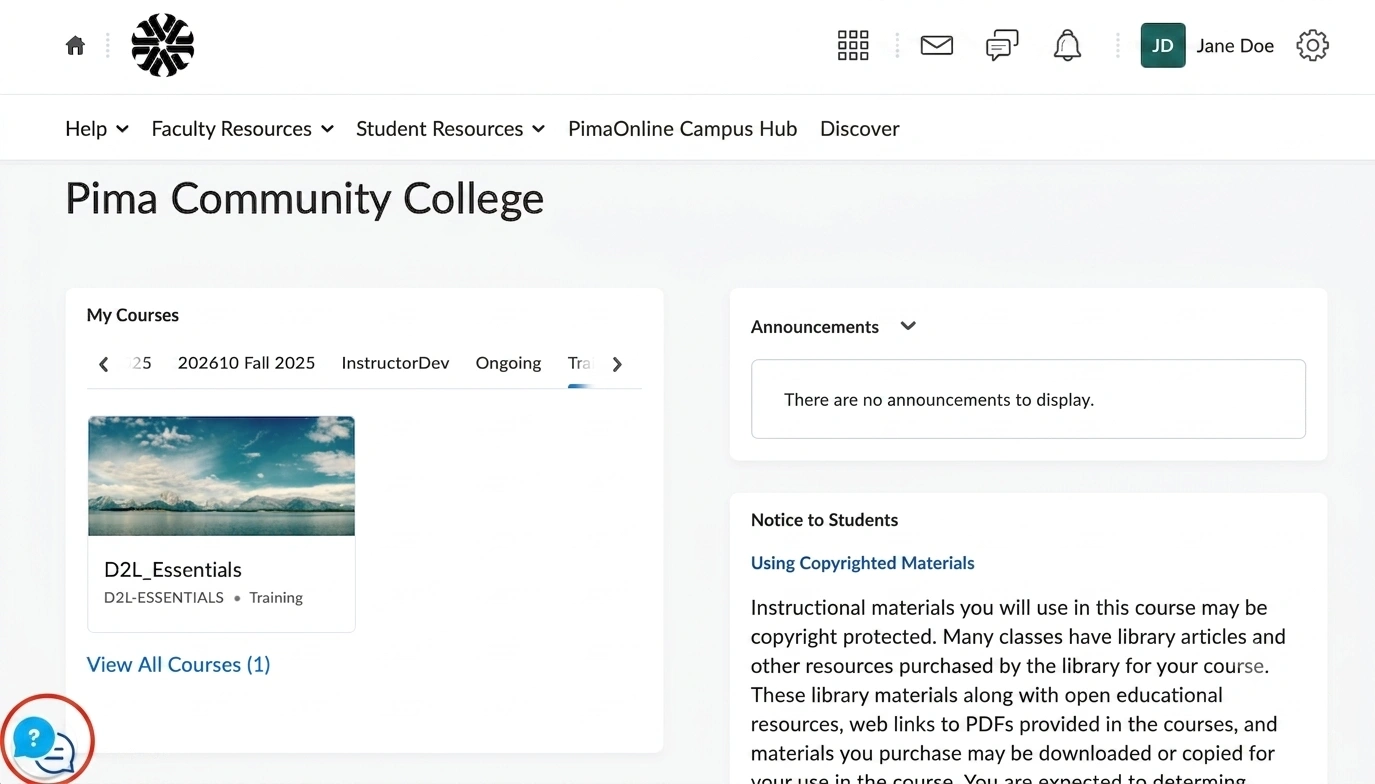
Pima Community College (PCC) is a large, multi-campus community college serving a high-volume and highly diverse student population across Southern Arizona. Its learners include adult students, dual enrollment high school students, and a significant number of fully online students. 30% of credit students were exclusively online in the 2025 academic year, with roughly half of PCC's spring and fall students partially online, yet even face-to-face students rely heavily on the Learning Management System (LMS).
With an unduplicated headcount of 40,642 in the 2024-2025 academic year, PCC operates at a significant scale. In practice, Brightspace is not simply a delivery tool for online courses, but the backbone of the learner experience: syllabi, course materials, grades, and faculty communication all happen within the LMS. Across modalities, the LMS is the center of teaching and learning.
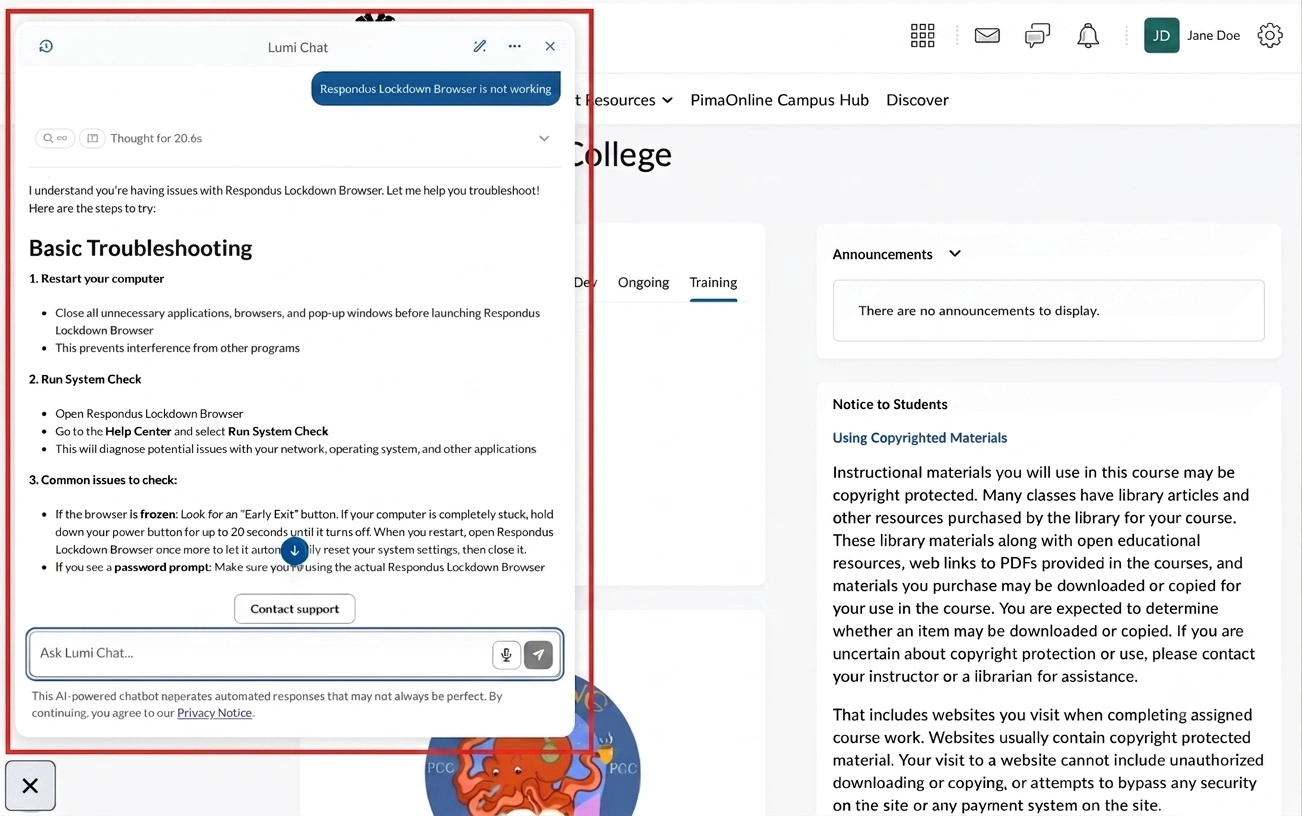
PCC partnered with LearnWise AI to deploy Lumi Chat inside Brightspace, alongside an integration with TeamDynamix (TDX). Lumi Chat went live in late June 2026, and the TDX integration is now functioning in production. The goal from the outset was straightforward: reduce friction in the most important digital space students inhabit, and align support with the rhythm of how learners work.
Context & Challenge
PCC's complexity comes from scale combined with rapid technological change.
Faculty are not monolithic: some prefer minimal technology, while others thrive using existing systems. The LMS team supports that full spectrum while maintaining clarity and consistency for students.
At the same time, student expectations around digital experience are evolving: many learners work full-time jobs, support families, and log into Brightspace late at night. Their time is scarce, and those late hours are often when institutional staff are least available.
At PCC, a way to bridge the gap was considering resources, time and availability. Already maintaining knowledge bases with accurate information, and building out FAQ sections, the issue was not information availability, but accessibility in context. For PCC, students and faculty frequently struggle to articulate the problem they are experiencing. They may not know which system is responsible or what terminology to use. The friction is not always technical, but cognitive.
For PCC, the goal was never automation for its own sake, but responsive support in alignment with the lived reality of learners and faculty.
Partnership with LearnWise AI
Partnering with Brightspace to deliver AI solutions reduced institutional risk and aligned with existing infrastructure. More importantly, Lumi Chat reflects how conversational technology has evolved. It is natural, capable, and straightforward to deploy inside the LMS environment.
Governance was also central to the decision. Faculty and students already navigate multiple systems, and every additional interface introduces training demands and cognitive load. By embedding Lumi Chat directly within Brightspace, PCC preserves interface consistency and avoids fragmentation.
As Tony Sovak, LMS & eLearning Quality Director, describes:
"I want as much as possible everything to exist in the same place for our learners and users. That includes help. If users are going to turn to AI for help, I would rather that interaction happen inside a system aligned with our values, governance, and support structures."
For PCC, support should not require leaving the learning environment. When users encounter friction, asking them to navigate to separate systems such as knowledge bases, ticket portals, or institutional sites adds complexity at the exact moment they need clarity.
Building the Assistant: How PCC Trained Lumi Chat on Real Support History
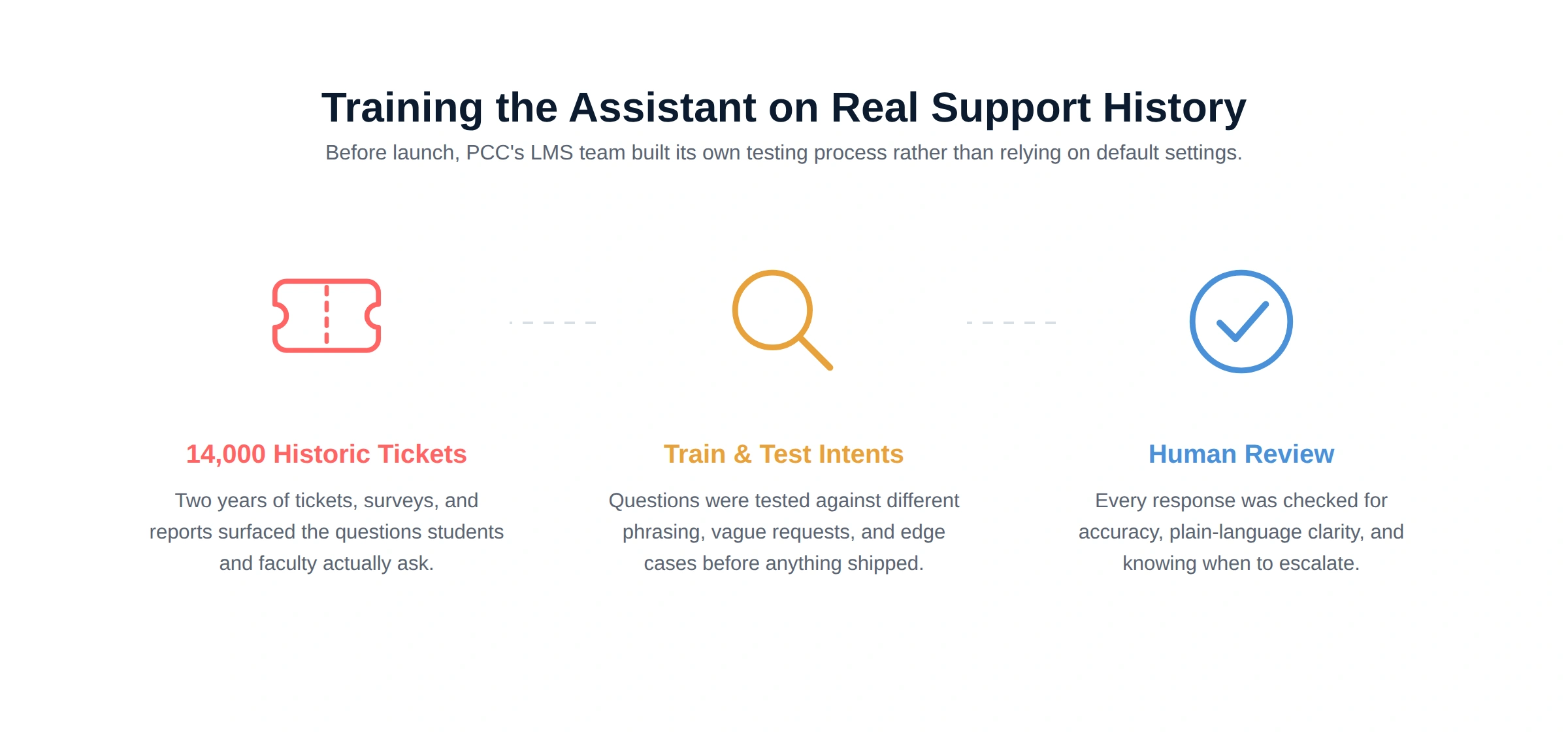
Before launch, PCC's LMS team built its own training methodology using two years of accumulated service history. They pulled two years of survey results, ticket data, and end-user reports into a Gemini notebook (formerly NotebookLM), then used it to identify the questions students and faculty asked most often, along with realistic variations: differently phrased versions, misspellings, and edge cases.
That question set became the basis for a structured testing process. Each candidate question was run against the assistant, and the response was logged and rated by both the student worker and the LMS team, round after round, as the underlying prompt and knowledge configuration were adjusted.
I want as much as possible everything to exist in the same place for our learners and users. That includes help. If users are going to turn to AI for help, I would rather that interaction happen inside a system aligned with our values, governance, and support structures.

An early finding shaped the final build more than anything else: PCC initially configured the assistant with heavy guardrails, limiting what it could reference and how it could respond. As those restrictions were loosened, response quality improved. Reflecting on the early rounds, the instinct to over-restrict came from experience building AI tools from scratch rather than working with a purpose-built product, where many of those safeguards are already handled.
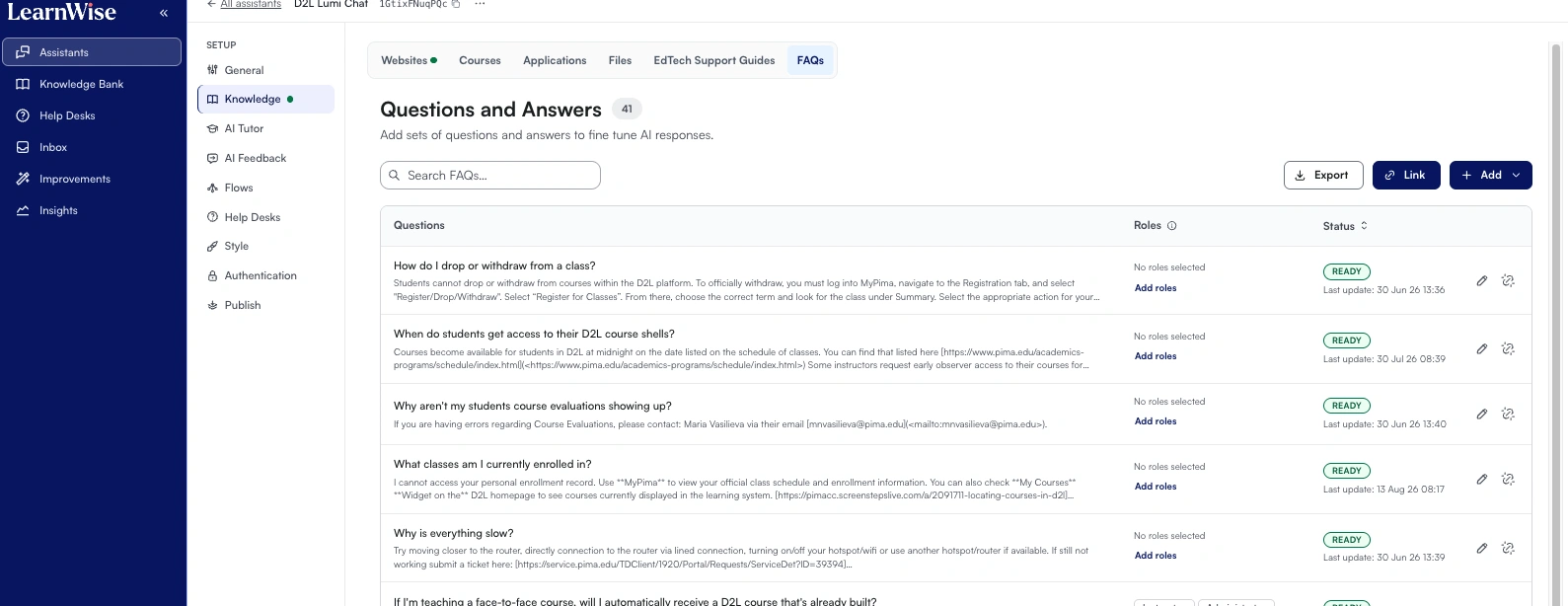
One specific design decision came directly out of this testing: PCC's own instinct was to have the assistant lean toward creating a ticket or pointing to a knowledge base article. A student worker testing from a student's perspective pushed back, wanting the assistant to resolve the question directly rather than redirect elsewhere whenever possible. That tension between the administrative view and the student view shaped the FAQ-based prompt baseline that went into production.
The Two-Gear Model: Balancing Speed and Empathy
One of the more distinctive design decisions to come out of PCC's build process was what the team calls a two-gear model of support: a transactional gear built for speed, and an emotional gear built for empathy.
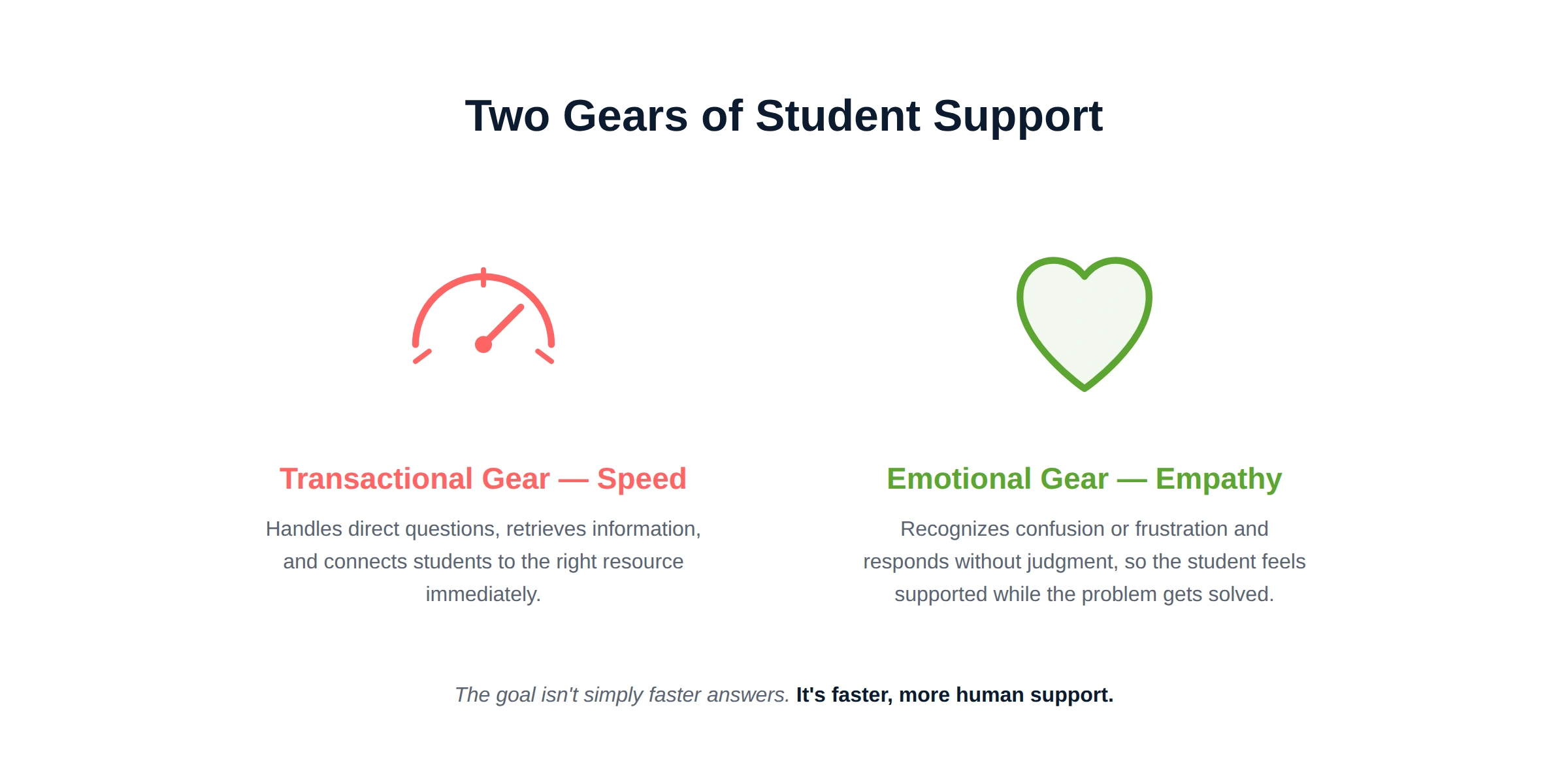
The distinction came out of negative feedback on earlier support tickets, often from students in stressful moments: a timed quiz malfunctioning at 11pm with no one available to help before the deadline passes. In situations like that, the instructor is usually the only person who can actually resolve the issue, and they won't see the message until after the quiz window has closed.
Rather than treat every request the same way, PCC built the assistant to recognize stress signals, explicit time pressure, an active exam or quiz, urgent language about a missed or failing submission, and respond differently when they appear: validating what the student is dealing with, then routing them toward the fastest realistic path to resolution, typically direct communication with the instructor, along with documentation they can point to.
Reimagining Ticket Intake with TeamDynamix Integration
PCC sees Lumi Chat as a solution with the potential to function as a unified conversational intake layer within the institution's enterprise help desk model.
For Tony Sovak and PCC's LMS team, the technical side of the partnership turned out to be one of the easiest parts of the whole project. The TeamDynamix integration in particular needed little more than a single build from LearnWise: as Tony described it, "that was very easy, LearnWise did the work," and once it was in place, "it just does it," routing tickets automatically without ongoing upkeep from his team. That same ease showed up in the product's built-in safeguards. PCC's first instinct was to lock the assistant down with the same heavy guardrails Tony was used to building into AI tools from scratch, only to find that loosening those restrictions improved the responses, since the safeguards he assumed he'd have to build himself were, in his words, largely "already there." The result was a rollout PCC could run mostly on its own: a small internal team testing, refining, and shipping the assistant on their own timeline, with LearnWise's side of the integration staying out of the way once it was working.
A next step under discussion is a planned handoff to TDX's own assistant for categories of requests that are already better served there, such as registrar, facilities, or hardware issues. That routing logic is still being worked out on PCC's side.
Ticketing systems are essential for tracking service and identifying trends. Yet users often resist them. By gathering required details conversationally and creating structured tickets when necessary, PCC aims to preserve accountability while reducing friction.
Early Results
Lumi Chat has been live at Pima Community College since late June 2026. The figures below cover usage through August 19, 2026.
In that window, Lumi Chat handled 614 conversations, answering 1,066 student questions with 1,680 responses. 467 unique students engaged with the assistant. 74 conversations were escalated to a human advisor, about 12.1% of the total, giving an AI resolution rate of 87.9%.
Student satisfaction averaged 4.19 out of 5 across PCC's early survey. Students rated the assistant on three measures: overall satisfaction (4.19), response speed (4.14), and likelihood to use the tool again for future Pima inquiries (4.05).
Emerging Use Cases
Adoption has surfaced uses beyond the original support-ticket scope. Staff have started using Lumi Chat as an internal knowledge-finding tool: locating scattered accessibility documentation to answer a compliance question, or finding a buried course enrollment link that PCC's own site search couldn't surface. Both use cases point to Lumi Chat functioning as a broader entry point into institutional knowledge, not only a support ticket intake tool.
Getting skeptical faculty on board has been less about persuasion than demonstration. Tony's approach is to meet the "what would I even ask it" reaction with something concrete: did you know you can file a ticket directly from the chat, or link your current enrollments with one click? For him, Lumi Chat works best framed not as a single-purpose support bot but as what he calls "a stepping-off product," an entry point into everything from the AI tutor to LMS admin self-service. He's noticed a pattern when he shows people how he personally uses it day to day: that's when, in his words, "their eyes kind of light up."
Looking Ahead
PCC's near-term plans include:
- A more representative usage survey. Both the usage window and the faculty sample are still early. PCC plans to rerun its feedback survey toward the middle or end of the fall semester to get a fuller picture of satisfaction on both sides.
- Refined TDX routing. Extending the handoff logic so that categories of requests already well-served by TDX's own chatbot (registrar, facilities, hardware) route there directly, rather than all arriving at PCC's LMS team.
- Continued visibility into usage patterns. PCC remains interested in the gap between raw ticket volume and lived user experience, and sees pattern-level insight into when and why help is requested as a way to inform documentation, onboarding, and proactive service improvements.
For Pima Community College, this remains responsible exploration: proportionate in scope, collaborative with LearnWise, and aligned with a long-term vision of reducing friction inside the most critical digital space learners use every day.
Want to see LearnWise AI in action?
Book a 30-minute session to see LearnWise AI in action, tailored to your campus. See real scenarios, test the assistant with your own questions, and discover how it supports students and staff 24/7, without leaving the tools and platforms you already know and love.
This update reflects a conversation with Tony Sovak following Pima Community College’s presentation at D2L Fusion 2026, alongside materials from that session. As D2L does not make breakout session recordings publicly available, this piece draws on the presenter's own materials and a direct interview rather than session video.



.png)


.webp)
%20(1).webp)
%20(1).webp)